Opening the Black Box: AI, Simondon, and the Conductor
Abstract
A theory-seminar essay on Matias del Campo's AI-driven architecture, read through Gilbert Simondon's philosophy of technical objects. Explores why we tend to either dismiss AI as an opaque black box or worship it as something mythical, and proposes a third stance: conducting it — treating AI as a participant with its own margin of indetermination, not a tool to master or a brush to wield.
Context / Problem
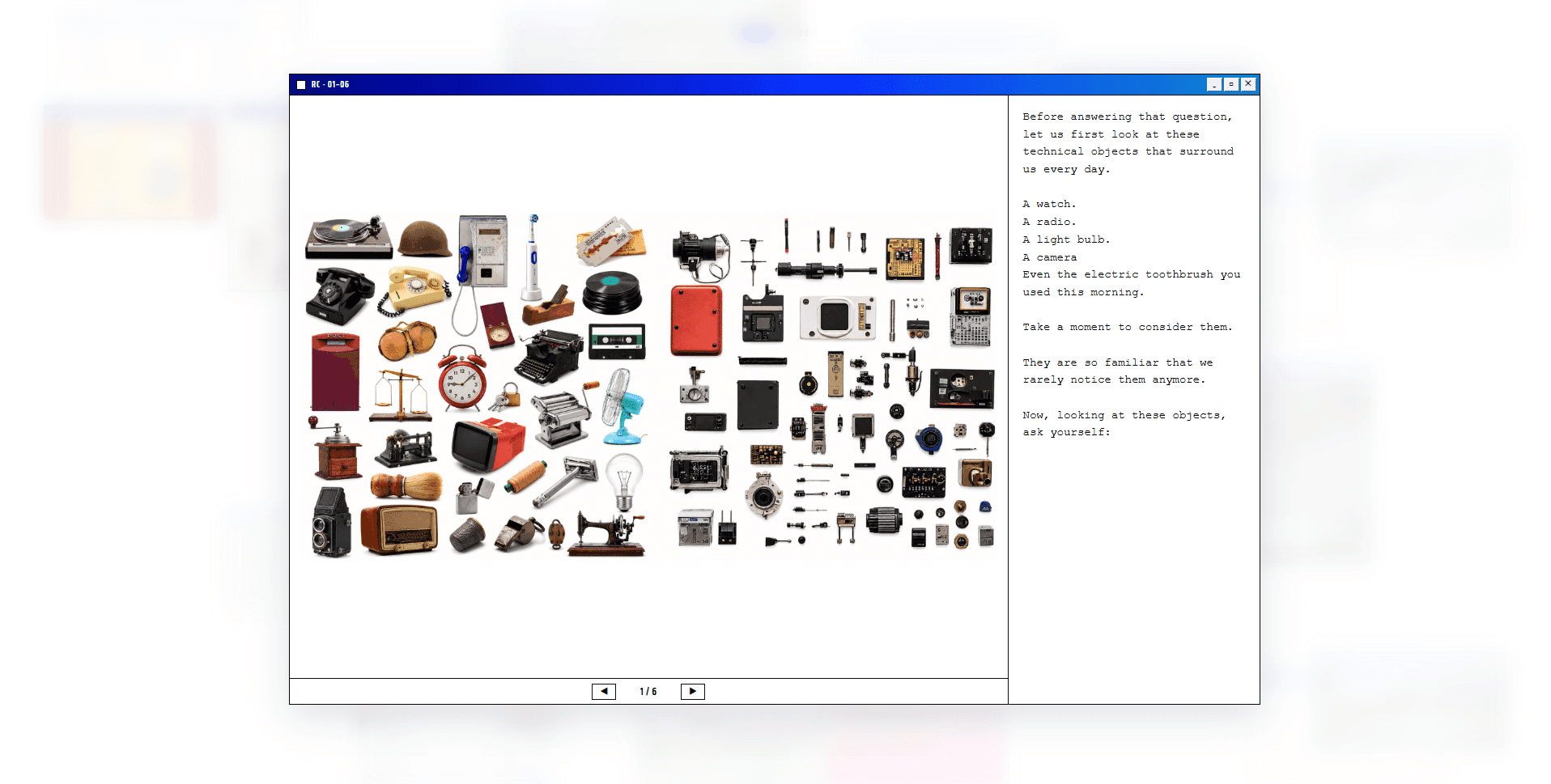
A theory seminar on architect Matias del Campo's AI-driven practice raised an uncomfortable question: are we using AI, worshipping it, or finally ready to conduct it? Answering it meant going back to a philosopher who predates the internet — Gilbert Simondon, whose 1958 study of technical objects argued that in a state of ignorance, machines appear to us as black boxes, their internal logic and evolution invisible to us.
Simondon identified two opposite failures that follow from that ignorance: dismissing the machine entirely as irrelevant, or elevating it into something mythical. Roland Barthes once described the Citroën DS as a goddess, and the same reflex repeats with every iPhone launch and every viral AI image — dismiss it, or worship it, but rarely understand it.
Methodology
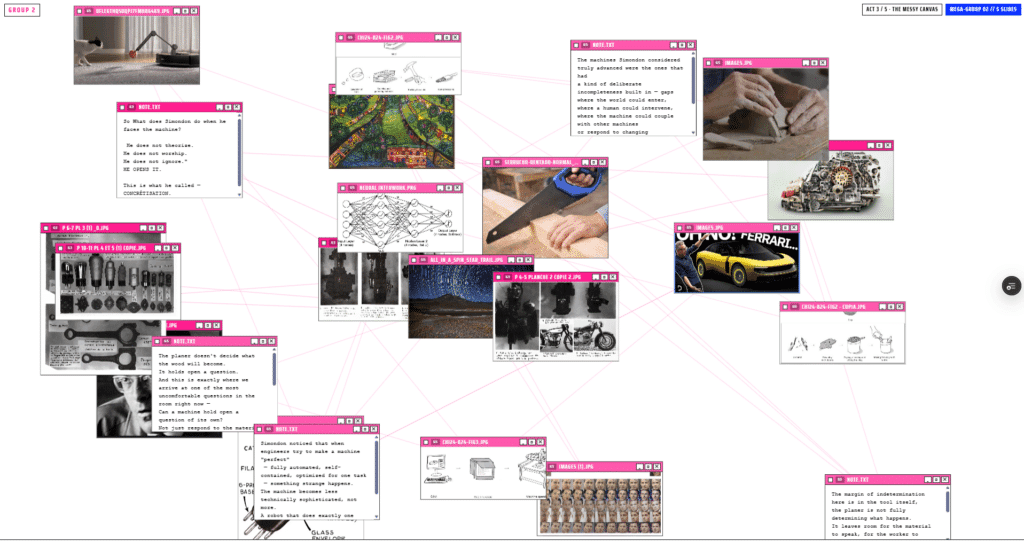
Simondon noticed something counterintuitive: when engineers push a machine toward being fully automated and optimized for one task, it becomes less technically sophisticated, not more — it closes. The machines he considered genuinely advanced kept a deliberate incompleteness, a margin of indetermination, where the world could still enter and a human could still intervene. A wood planer illustrates this well: it doesn't fully determine the outcome, it holds a running dialogue open between tool, material, and the worker's hand.
The seminar tested that idea against a built case: the Robot Garden at the University of Michigan (2021), whose ground textures came from satellite imagery fed into a neural network trained on thousands of architectural elements, then left to project those learned elements back onto the terrain — producing a landscape that reads as natural, but carries a distinctly non-human strangeness.
Results
The discussion turned to whether AI can create something genuinely new, or only recombine what it already knows. Margaret Boden's framework separates three kinds of creativity: combinational (unlikely combinations, like the paths StyleGAN's latent space interpolates between), exploratory (moving through the edges of a conceptual space), and transformational (rewriting the rules of the space itself, as in Adolf Loos's Raumplan). A generated Ferrari looked striking but was instantly legible — familiar futurism projected forward, not something new.
Del Campo's Deep House pushes further: two datasets — a modern facade set and a floor-plan set — were trained with StyleGAN2 and deliberately pushed toward overfitting and data scarcity, producing uncanny, defamiliarized results rather than smooth accuracy. The approach borrows Viktor Shklovsky's concept of estrangement (later staged by Bertolt Brecht in theatre): make something familiar just strange enough to sharpen attention, so the house reads as strange, yet still recognizably a house.
Conclusions
Del Campo doesn't use AI as a brush — he conducts it. Simondon's own image fits: the good technician is not the supervisor of a squad of slaves, but the organizer of a society of technical objects that need a human the way musicians in an orchestra need a conductor. Creativity, in this framing, isn't a metaphysical spark located in the machine or the designer alone — it's an inferential process distributed across human, machine, and material, with the architect mediating and translating the model's statistical relations into something cultural and spatial.
Simondon's original call still holds: not to dismiss the machine, nor to worship it, but to open the box, locate its margin of indetermination, and stay inside it — as the permanent organizer of a society of machines that need us as much as we need them.
Project Documentation